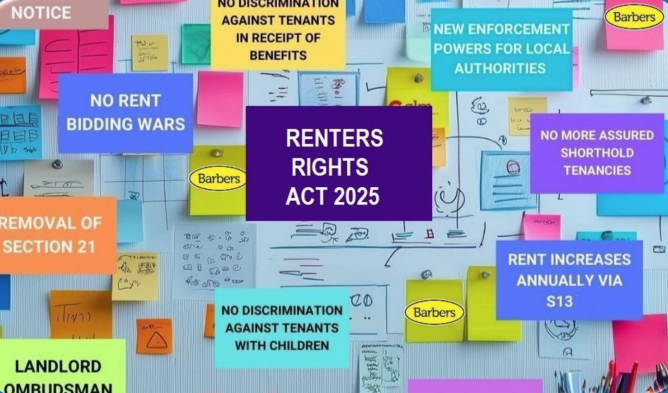
renters Rights Act 2025
THE RENTERS RIGHTS ACT 2025
The Renters Rights Act is the most significant reform of the private rented sector since the Housing Act 1988. The bill was introduced to Parliament on September 11th 2024 and has wide ranging implications for landlords, tenants and letting agents alike.
Key elements of the bill, such as the abolition of Section 21 notices and the ending of Assured Shorthold Tenancies, will be implemented on 1st May 2026. Other elements such as the Private Rented SectorDatabase, the landlord Ombudsman scheme, decent homes standard and Awaab’s law will be introduced in years to come with the latter not scheduled to be looked at until 2035.
In this guide we will look at the various elements of the bill and how they will affect landlords. At Barbers, we are ready for the changes and our staff have become experts in compliance. We already have in place new processes to ensure we comply with the changes
A SINGLE SYSTEM OF PERIODIC TENANCIES
From 1st May 2026 all fixed term Assured Shorthold Tenancies will be replaced by periodic tenancies under the Renters Rights Act (2025). One of the main reasons the Government is making the change is to give tenants more freedom to leave substandard properties.
Existing Assured Shorthold tenancies will become periodic overnight on 1st May 2026, irrespective of how long the fixed term was at the commencement of the tenancy. Tenants will need to give two months’ notice to end the tenancy and that will need to fall into line with the date they pay their rent. Tenancies will operate on a rolling, month to month basis and there will be no official minimum term.
RENT INCREASES VIA SECTION 13 NOTICES
The new act will introduce significant changes to standard procedures when dealing with rent increases. The principal change is that rent review clauses in tenancy agreements will no longer be permitted.
Currently, the regulations dictate that the landlord must give one months’ notice of the intention to increase the rent, this will change to two months. Landlords will only be able to raise the rent once a year. The new bill does give the tenant the right to dispute a rent increase via The First Tier Tribunal (FTT). The tenant has the two months to challenge the increase, beyond that it would be considered accepted.
We have selected a number of the grounds as an example of the reasons for regaining possession.
- If the landlord or a family member wishes to move into the property. This can only be achieved after the tenancy has exceeded 12 months. 4 months’ notice must be given from month 8 of the tenancy – at the earliest.
- If the landlord intends to sell the property. This can only be achieved after the tenancy has exceeded 12 months. 4 months’ notice must be given from month 8 of the tenancy – at the earliest.
- For student landlords not affiliated with an educational institution who need the property for new student tenants before the start of the academic year.
- If a landlord wishes to demolish or redevelop the rented property to the extent that the tenant cannot live there. 4 months’ notice is required.
- If the tenant has committed “serious anti-social behaviour”
- If the tenant does not have the right to rent in the property
- If the tenant is at least three months in arrears (or 13 weeks if rent paid weekly or fortnightly)
The following are examples of some of the discretionary grounds that can be used.
- If the landlord has provided accommodation that is like-for-like for the current tenancy
- If the tenant is in arrears with their rent but less than Ground 8.
- If the tenant is consistently late paying their rent but is not currently in arrears with their rent.
- If the tenant has breached the tenancy agreement, excluding rent arrears.
- If the tenant has neglected the property and its condition has deteriorated.
- If the tenant is a nuisance or annoyance to the neighbours or is using the property for illegal or immoral activity.
- If the tenant has been convicted of an indictable offence during a UK riot
- If the tenant was given a tenancy with a false statement
The last realistic date for serving a Section 21 notice would be 30th April 2026, although that would be cutting it very fine. It would need to be acted upon before the notice’s natural end date, if it were to be relied upon in court.
The need to use a qualified agent to manage your property will now become imperative for several reasons, with the main one being the impact of dealing with the more complex Section 8 notices as mistakes will be costly. Courts will reject notices with incorrectly cited grounds, prolonging an already difficult process.